When a Policy Label Does More Work Than the Definition
Learn to read policy labels closely and identify what a promise means in practice, which details remain unsettled and where to ask for clarity.
A policy label can promise a particular kind of action without telling you what an agency must actually do. In an “open data” plan, for example, the phrase might refer to publishing files, providing usable formats or allowing people to reuse information; those are different commitments. Reading the label alongside the document’s operative wording shows which one the policy proposes.
That distinction matters when a label travels between a ministerial announcement, a council plan and a service contract. The name may stay the same while the mechanism changes. Rather than judging the slogan, trace how it is meant to alter the work of the institutions involved.
What action sits behind the label?
Look for the policy instrument: the means by which the proposal is meant to operate. It might be a legal duty, a grant, a public service, a standard, an information campaign or an agreement between organisations. These instruments give a familiar label its practical shape.
Pay particular attention to the verbs. “Require” signals a different kind of commitment from “encourage”; “fund” points to resources, while “coordinate” points to work shared across bodies. The verb alone does not settle what will happen, but it helps you locate the operative clause and the institution responsible for it.
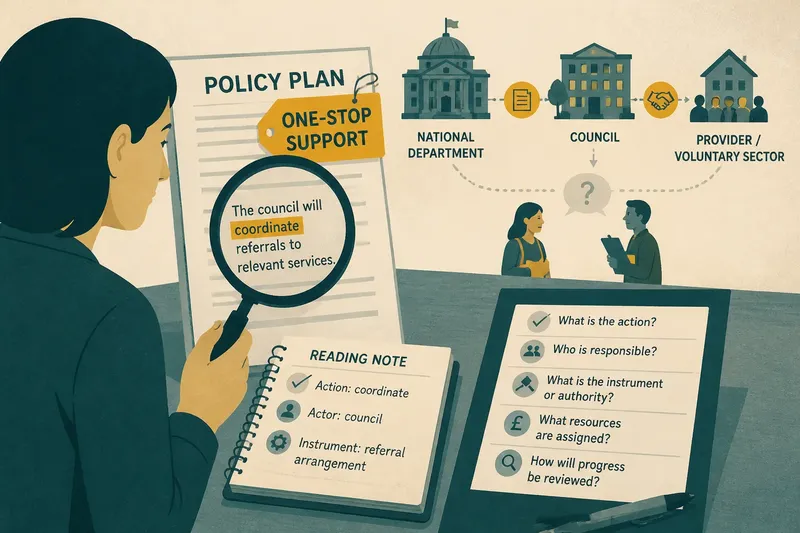
A useful reading note can be brief: write down the action, the actor named, and any instrument or authority cited. If the document says only that an agency will “support” a goal, note that the form of support is unspecified rather than treating the word as a service promise.
Who has to make the policy work?
Policy language often obscures the division of labour. A national department may set a standard, a council may arrange local provision, and a contractor or voluntary organisation may deliver part of the service. If the document names only the lead body, check whether other responsibilities are described elsewhere.
Compare the stated task with the powers and resources assigned to the actor. A duty without a named route for carrying it out can leave discretion with frontline staff; a funded programme may still leave providers to decide how to organise access. These are questions about institutional design, not merely wording.
Imagine a council plan labelled “one-stop support” that names the council as lead but says local charities will refer residents to relevant services. The plan identifies a coordination role, not necessarily a single place where residents can obtain help. A reader could ask the council which organisation handles referrals and how a resident is told what happens next; the answer would clarify whether the label describes a shared pathway or a single service point.
How can you tell what the label commits an institution to?
Read the label against the operative text, then record the exact commitment and the document location. The sequence below is useful when comparing a policy announcement with its formal plan or delivery guidance.
- Find the sentence that uses the label and note the document, section and date. If the label appears only in a headline, treat it as a description rather than an operative commitment.
- Locate the action verb and its object. If the text says an agency will “publish guidance”, record guidance as the action; if it states no action, ask for the clause that gives the label practical effect.
- Identify the named actor and any other bodies assigned a role. If responsibilities are missing, ask which institution owns delivery; if roles are listed, compare what each is expected to do.
- Find any cited authority, funding route, standard or delivery arrangement. If none is stated, record the mechanism as unresolved; if one is stated, check the document it points to for the working detail.
- Check what would count as completion or compliance. If there is no reporting or review arrangement, ask who will explain progress; if one exists, note what it records and what it leaves outside its scope.
- Compare the result with the label. If the text supports a narrower action than the label suggests, describe the commitment in the narrower terms; if it supports the broader promise, cite the operative wording rather than relying on the label.
Each item links a claim to a decision: whether the label is only descriptive, whether a responsibility is clear, or whether a reader needs a clarification. That makes it easier to discuss policy design without arguing over a phrase in isolation.
What should you look for in the wording?
Several features are easy to confuse. A target describes an intended result or level of activity; a standard sets a rule or expectation; an indicator records something chosen for monitoring. A policy can include one without including the others.
- Action: If the text names a concrete task, such as publishing guidance, describe that task; if it offers only an aspiration, ask what action is intended.
- Authority: If the document cites a legal power or formal duty, check the scope of that authority; if it cites none, ask whether the commitment is voluntary or set elsewhere.
- Resources: If a funding or staffing route is identified, note what it supports; if no route is named, ask how the assigned work is meant to be carried out.
- Responsibility: If one body is clearly assigned the task, record its role; if several bodies are named without a division of work, ask who handles each part.
- Review: If reporting or oversight is specified, note who receives the information; if not, ask how the public or accountable body will learn whether the commitment was carried out.
- Scope: If the policy states where or to whom it applies, use that boundary; if the boundary is absent, ask which services, places or organisations are covered.
These checks are not a scorecard. They help distinguish a clear commitment from an unresolved design choice, without assuming that every policy needs the same instrument or reporting arrangement.
Which questions help clarify a policy label?
What does the label mean in the operative text?
Search for the clause that describes an action, rule or service, rather than relying on the announcement’s heading. If no such clause appears, ask which document gives the label its formal meaning.
Which institution is responsible for delivery?
Check whether the document names a lead body and assigns roles to partners, providers or local authorities. If it does not explain who makes day-to-day decisions, ask the lead body where those responsibilities are set out.
Is the commitment a duty, an offer or an aspiration?
Look for the wording and authority that establish its status, then distinguish binding requirements from voluntary action or stated intent. Where the status remains unclear, ask the issuing institution to identify the relevant rule or explain that the proposal is not binding.
How will anyone know the commitment was carried out?
Look for a reporting, oversight or review arrangement, and note what it records. If the document specifies none, ask who is expected to account for delivery and through which channel.
How should you describe what the label means?
Use language that matches the strength of the text. “The plan requires the agency to publish guidance” is more precise than “the plan delivers open data” if publication is the only stated action. If the action is still unspecified, say so plainly and point to the missing clause or assignment.
In a policy label reading, that small discipline keeps the discussion focused on the institution’s actual commitment, not on a promise inferred from its name. Treat the label like a parcel’s outer wrapping: it identifies what is being presented, while the contents and handling instructions determine what someone can expect to receive.