The Policy Memo Before the Policy Era
A policy memo turns competing options into a decision-ready account, but its structure also determines which trade-offs and uncertainties leaders notice.
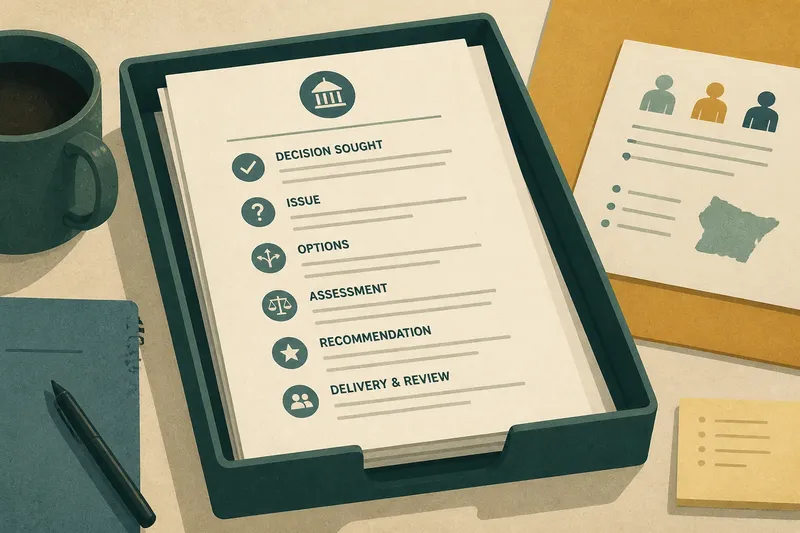
A policy memo does more than carry a recommendation into a meeting: its layout helps determine which options, trade-offs and doubts a decision-maker sees first. Before a proposal becomes an established policy, the memo often serves as a small institutional stage on which a complicated question is made manageable. Understanding that stage helps readers assess not only what a memo says, but what its form makes easy to overlook.
Why does a memo shape the decision?
Senior officials rarely have time to read every report, operational note and stakeholder submission behind a decision. A memo condenses that material into a document that can be scanned, discussed and acted upon. In doing so, it creates a route through the issue: a problem is stated, choices are arranged, consequences are described and a decision is requested.
That route matters because attention is limited. A reader may encounter the recommendation in the first paragraph, then use the options section to check whether alternatives were considered. If one option is described in crisp, concrete language and another in vague terms, the difference can shape the discussion before anyone weighs the underlying evidence.
Think of a memo as a tray holding papers for a meeting. The tray does not decide what the group chooses, but it determines what is placed within reach and what remains elsewhere. Supporting documents still matter; the memo signals which parts deserve immediate attention.
What does a decision-ready memo usually contain?
There is no single required template across public institutions. Still, many decision memos contain a recognisable set of elements: a clear request, a concise account of the issue, options, a recommended course, reasons for the recommendation, and implications for delivery. The order and labels vary, but the reader should be able to tell what choice is being asked for.
- Decision sought: State what the authorised person or group is being asked to approve, reject or direct.
- Issue: Define the immediate question and explain why a decision is needed now.
- Options: Set out the feasible alternatives, including the consequences of taking no new action where relevant.
- Assessment: Compare effects, costs, operational demands, distributional consequences and uncertainties.
- Recommendation: Identify the preferred option and connect it to the criteria used to judge the choices.
- Delivery and review: Clarify who would act, what needs to be settled and how officials would know whether the approach is working.
These elements are useful because they separate different kinds of claims. The issue section describes the situation; the assessment explains likely consequences; the recommendation expresses a judgement. When those roles blur, a value choice can appear to be a neutral fact, or a prediction can sound more certain than it is.
A memo also needs to show where its account comes from. It can point to internal analysis, operational knowledge, consultations or other supporting material without reproducing every detail. The aim is not to turn the memo into a filing cabinet; it is to let a reader trace important claims and ask for more information when needed.
How can compression change what readers notice?
Compression is unavoidable, but it is not neutral. A short memo cannot give equal space to every group affected, every possible outcome and every uncertainty. Choices about what to summarise, place near the top or move into an annex shape the practical meaning of the document.
Consider how options are named. “Proceed with the existing service” sounds different from “make no changes”, even if both describe the same course. The first may suggest continuity and competence; the second may sound like neglect. A fair comparison uses labels that describe the actual choices rather than quietly praising one of them.
Measures of success can also be made more visible than the effects they do not capture. A memo focused on processing speed may give less attention to whether people can use a service, whether access differs across communities, or whether staff can sustain the proposed arrangement. The answer is not to cram every concern into the opening page. It is to name the main criteria and make significant omissions or unresolved effects visible.
Placement carries meaning too. A risk mentioned in a late annex may receive less attention than a benefit in the opening summary. A recommendation presented before the options can anchor discussion around defending it. Neither convention makes a memo improper by itself, but readers should notice how sequence and emphasis guide their attention.
How should a memo show uncertainty and trade-offs?
A useful memo distinguishes what is known from what is expected and what remains uncertain. It does not need elaborate forecasts to do this. It can state which assumptions underpin a likely outcome, which groups may experience different effects, and what information would change the recommendation.
Imagine a transport department considering changes to a local bus timetable. The team has reports that some journeys are poorly timed for shift workers, but it lacks a clear picture of how a proposed schedule would affect evening connections. A memo could recommend a timetable change while stating that the evening effect is uncertain, identifying the information needed to check it, and explaining what officials would revisit if connections deteriorated. The expected benefit remains a reason for action, not a claim that every consequence is settled.
Trade-offs deserve similar treatment. A proposal may improve one objective while making another harder to achieve. A reader needs to know which objective has priority, who bears the less favourable consequences, and whether the choice can be adjusted later. Writing “there are risks” is not enough if the memo never says what those risks mean for people or delivery.
Uncertainty can also be useful to decision-makers. If a choice is reversible, the memo can distinguish an initial decision from later decisions that depend on what happens during implementation. If it is difficult to reverse, the document should make that constraint plain. This helps the reader judge how much confidence to demand before acting.
What should you look for when reading a policy memo?
Who is being asked to decide?
Check whether the request names the decision and the person or body with authority to make it. If the memo asks for general support but leaves the concrete choice unclear, readers may leave the meeting with different understandings of what was approved.
Are the alternatives described on equal terms?
Compare the specificity and language used for each option, including the consequences of taking no new action. If one choice has detailed benefits and another is reduced to a dismissive label, the comparison may be doing persuasive work before the analysis begins.
Which effects are prominent, and which are missing?
Look at the criteria used to compare choices and ask whose experience those criteria capture. A memo can be concise while still identifying important effects that are not covered by its main measures.
What could change the recommendation?
Find the assumptions, uncertainties and conditions that matter to the proposed course. If none are stated, ask what new information or delivery problem would prompt officials to reconsider it.
What makes the format accountable without making it unwieldy?
Accountability does not require turning every memo into a lengthy report. It does require a readable link between the question, the options, the reasons for choosing and the follow-up needed. A brief annex can hold technical detail, while the main text explains why that detail matters to the decision.
Good handling of evidence also means separating evidence from judgement. An analysis may estimate likely effects, but choosing among competing objectives remains a decision about priorities. The memo should say which priorities inform its recommendation instead of presenting that choice as the only possible reading of the analysis.
Readers can also check whether the recommendation fits the authority and capacity available. A proposal may sound coherent on paper yet depend on another body’s agreement, staff time or information that is not in place. The memo should make those dependencies visible, so the decision is not mistaken for a complete delivery plan.
Review arrangements should be proportionate to the question. A memo might identify what officials will monitor, who will receive that information and which decision could follow if circumstances change. That gives later scrutiny a clear point of reference without pretending that every outcome can be predicted in advance.
Before treating a recommendation as self-evident, read the policy memo as both an argument and an instrument of attention. Ask what was included, how the choices were framed and what would make the preferred course worth revisiting. That habit turns a compact document into a more useful invitation to judge, not merely a request to agree.